Content engineering
People Also Ask Content Strategy for SEO and AI Search
Build a People Also Ask question map with intent clusters, source checks, a worked brief, and a reusable template for SEO and AI search planning.

In brief
- Turn observed questions into a page brief with intent groups, evidence, destinations and acceptance checks.
- Use the field case to reject irrelevant candidates and the export example to write a complete answer.
- Track recorded query coverage after publication; expand the page when another reader task needs an answer.
Sections in this article
Who this is for
Good fit
- SEO leads and editors turning noisy search questions into a page brief.
Not for
- A keyword-volume forecast or a live export of Google PAA questions.
ur content research once took a question about citation-ready pages and returned a grammar lesson about make versus makes. Shared words made the suggestion look relevant. The reader's actual task made it useless. The failure, preserved in the field case below, is why a People Also Ask strategy needs editorial decisions between question collection and publication.
A PAA content strategy turns observed questions into supported answers on the right pages. Collect the wording and search context, group questions that need the same answer, choose a destination, and give the writer the evidence and acceptance criteria. The output is a usable page brief, not a list of phrases to repeat.
Start with the field case if you need to improve research quality. Use the worked export-question map if you need a brief today. Follow the measurement section when the page is published. The export scenario is a labelled teaching example; the incident and cache counts are retained operational records.
Our August 13, 2026 editorial incident recorded a failure that a polished keyword spreadsheet would have hidden. A seed about what makes a page citation-ready returned a candidate about the English grammar distinction between make and makes. The selection logic accepted shared wording as a relevance signal. Another candidate concerned references between JSON Schema documents, a developer-validation problem rather than the intended AI-search publishing task.
The historical incident is preserved in our engineering journal, and the question examples survive in executable regression cases. During the September 7 research revision we reran those cases against the filter then in use. That replay tests the recorded filter version's classification behavior; it does not recreate the original Google panel. The field-note extract and replay record distinguishes the dated incident from the current local check.
The important failure was not just a bad score. When the filtered pool was empty, a fallback restored the original unfiltered questions. The system had performed a relevance check and then bypassed its own result. An editor could reproduce the same mistake manually by selecting the least irrelevant suggestion because the brief requires a topic that day. An empty relevant set should trigger a different research input, not promote the rejected set.
The third row is a positive test control, not a newly collected search observation. This distinction lets the case teach a reusable rule without inventing demand: relevance must live in the question and its answer, not merely in the seed that produced it. Strip scraped site names from titles for readability, but preserve the original string privately so the collection can be audited.
For your own map, add two columns before volume or priority: actual reader task and reason to retain. Ask an editor to fill them without looking at the seed. If they cannot explain how answering the question serves the page's audience, set it aside. This catches semantic drift before a writer spends hours producing an excellent answer to the wrong question.
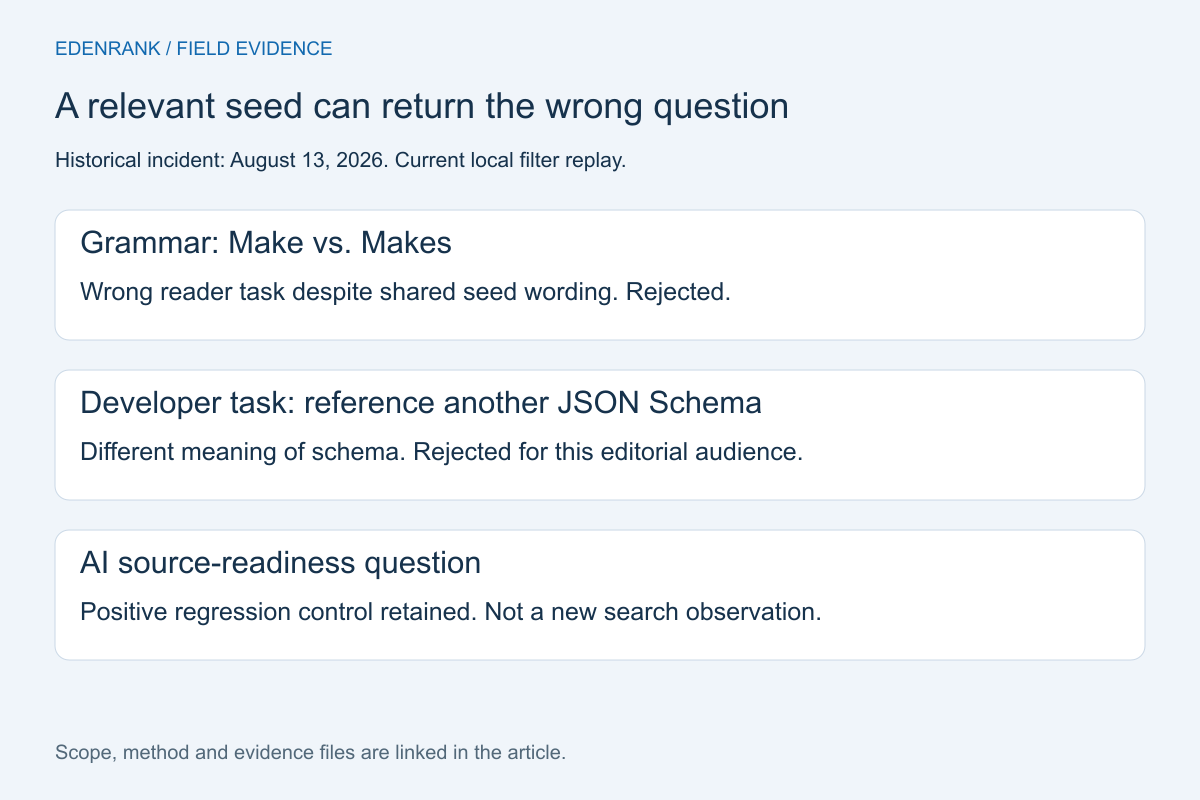
Question-filter decisions from the retained incident
| Preserved candidate | Why it looked relevant | Actual reader task | Editorial decision |
|---|---|---|---|
| Make vs. Makes: What is the Difference? | Shared wording with a citation-ready seed | English grammar | Reject for this audience |
| How to reference to another JSON Schema? | Contains schema and reference | Developer schema composition | Reject for this AI-search brief |
| What makes a page citation-ready for AI engines? | Explicit AI-search task | Improve a page as a source | Retain as a regression control |
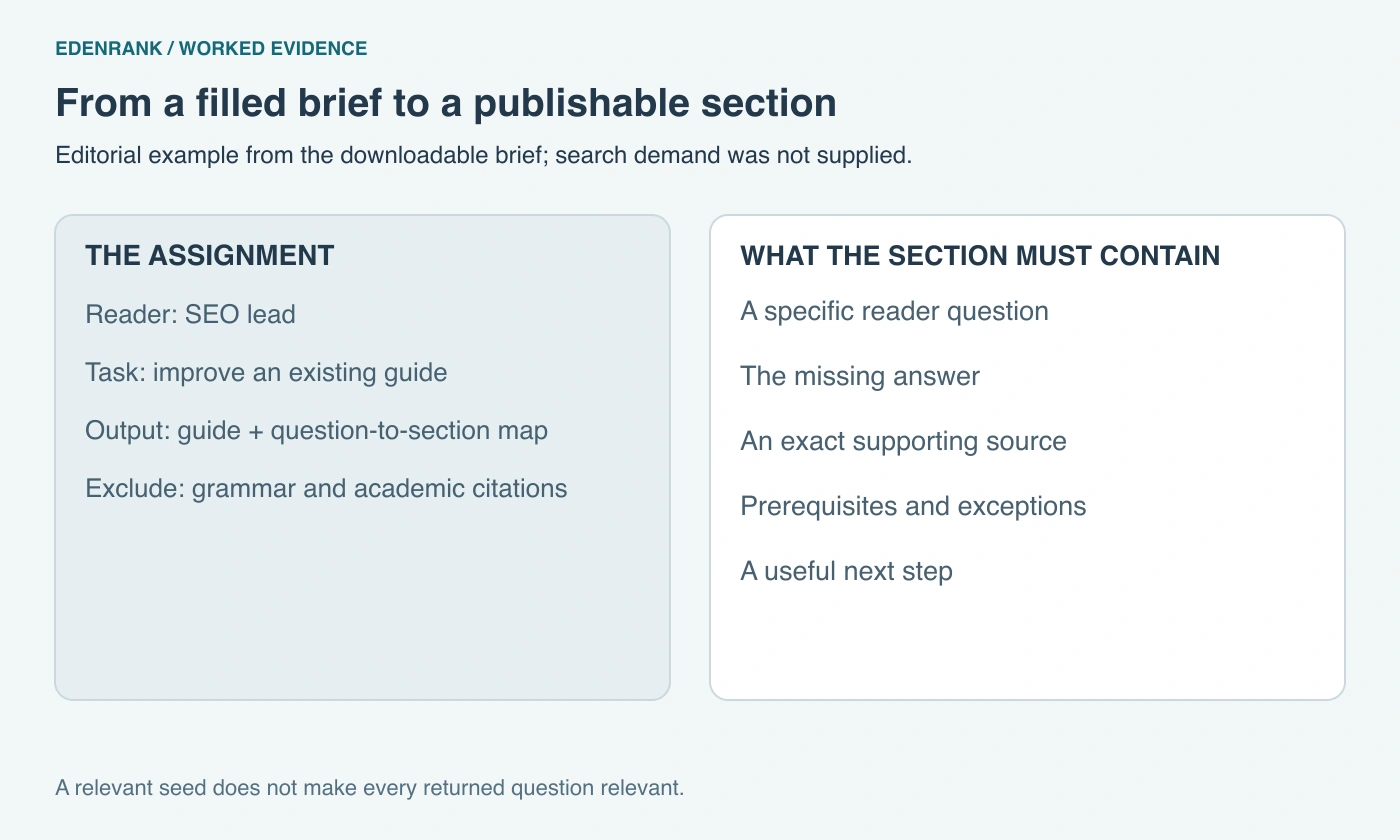
Give the writer a decision, a reader and a destination before handing over keyword research. In this guide's fictional support-software example, the assignment is: help an operations manager decide whether an existing ticket export is sufficient for migration. The destination is the current export guide. The missing information concerns permissions, included records and attachment handling.
A useful opening draft is: “Before exporting support tickets, confirm your role, the fields included in the file and how attachments are delivered. An export of message text alone may not provide the records your destination system needs.” This is editorial framing, not a claim that a named vendor has those limitations. The product-specific answers must come from that product's documentation or an inspected export.
The writer then needs an evidence checklist: the applicable plan and role, the export format, the field dictionary, a representative file, and the destination's import requirements. The attachment question stays pending until one of those records resolves it. The brief should identify a person who can obtain the missing evidence, so an unresolved row produces a concrete request instead of vague extra research.
Use the filled page brief as a separate example of a citation-readiness assignment derived from our incident. The question-map CSV retains the incident candidates and a blank observation row. These downloads show the record structure; the export scenario below shows how to apply it to another reader task.
At handoff, hide the seed query and ask the reviewer to explain why each retained question matters. Then reveal the seed. If the only argument for a row is that its wording resembles the seed, remove it. If its answer changes the user's decision, keep it and identify exactly where the page will answer it.
See where your brand appears in AI answers - and where it does not.
Run a first-party brand check across supported answer engines. Results are measured without a promised citation or conversion. Browse all free tools
A question displayed in PAA is evidence that the question appeared in that observed search experience. Save the query, country, language, device context, and collection date alongside it. Do not silently turn the observation into a claim that a fixed percentage of your customers ask the question. You have collected a search-surface observation, not surveyed your audience.
Autocomplete supplies another form of phrasing evidence. Google's Search Console performance documentation explains the query, page, impression and click reports available for your property. Use their actual filters and reporting scope. Support tickets reveal problems from people who contacted your business. AI response testing shows what a specified engine returned for a specified prompt. These sources can overlap, but they do not have interchangeable populations or denominators.
Google describes query fan-out in its AI search guidance. That description does not establish that the visible PAA box is the same query set. Use PAA as a research input, and record AI response observations separately. Connecting them is an editorial hypothesis to test, not a fact to assume in the introduction of every page.
A second check made the source-label problem measurable. On September 7 we inspected eight retained question-cache entries in the local editorial system, saved between June 8 and August 31. They contained 48 candidate rows: 36 labelled serp_question_candidate and 12 labelled fallback_question. None was labelled people_also_ask. Those are stored row labels, not an independent reclassification of the original search pages, and the count is not deduplicated question demand.
The cache inventory preserves the counts, dates and source-file hash. This small local result explains why a worksheet should have a source-type column: calling all 48 rows PAA would have turned inferred SERP candidates and local fallbacks into a search observation they did not document. Keep such candidates if they help research, but retain their real provenance. The next editor can then decide what still needs a fresh observation instead of inheriting a misleading label.
Research inputs and their evidential scope
| Input | Useful evidence | What it does not establish |
|---|---|---|
| Observed PAA question | Wording and related question in one search context | Monthly demand or private AI fan-out |
| Customer support question | A problem reported by an actual contact | Prevalence across the whole market |
| Search Console query | Recorded performance for your property | Every query or every audience exposure |
| Saved AI answer | Mention and citation in that response | Population reach or conversion impact |
Write a one-sentence assignment: help a named reader complete a named decision under named constraints. For the example, use: help a support operations manager evaluate whether ticket history can move from an existing help desk to another system without losing required records. That assignment rules out unrelated questions about personal email exports and general customer-service careers, even if their wording shares a keyword.
Next, state what the page can actually support. If you have tested only a CSV export, you can describe that test and its conditions. You cannot imply that attachments, private notes, or user identities survive a full migration unless you inspected them. Distinguish public documentation, first-hand testing, and unresolved questions in the research record. This makes the eventual article more useful than an answer that sounds complete but omits the difficult edge cases.
Choose a primary destination before expanding the inventory. An existing export guide might already answer most of the questions. Improving that guide could be more useful than commissioning another article. A new comparison page makes sense when the reader needs to choose between products using common criteria. A troubleshooting page makes sense when a specific failure has a different diagnostic path.
The boundary is also your stopping rule. Stop collecting variants when the additional questions no longer change the reader's decision, the required evidence, or the page structure. A larger spreadsheet is not automatically a better brief. Record out-of-scope questions in a parking list so they do not quietly inflate the current article.
For a broader planning workflow, use the buyer-question content-cluster guide.
Use a small set of seed searches representing different stages of the task: understand the concept, compare options, perform the action, and recover from failure. Record the exact seed rather than a cleaned-up topic label. If you expand a PAA question, record that expansion as a separate observation linked to the original seed. This preserves the path by which a seemingly distant question entered the inventory.
Combine those observations with buyer-owned evidence. Remove personal details from support examples, retain the substance of the problem, and distinguish a verbatim question from an editorial paraphrase. A sales note saying that migration is difficult is not itself a customer's exact query. Label it as an inferred topic until a more precise question emerges.
Collection should be finite and repeatable. For an initial page, set a time box and define which seeds, locales, and sources you will examine. These are planning choices, not recommended statistical sample sizes. Repeating the same bounded method next month is more informative than comparing a casual five-minute search with an exhaustive afternoon of expansions and calling the larger inventory demand growth.
Keep raw observations separate from the deduplicated map. Several observations can point to the same question record. That relationship lets an editor inspect the evidence without filling the published page with every phrase that happened to appear. If using an external collection service, retain its collection settings and respect the source's access terms; the article does not require scraping or bypassing a restriction.
Prioritization should explain why an answer is worth producing now. Begin with whether the question belongs to the intended audience and whether answering it helps a meaningful decision. Then examine the evidence needed to answer it correctly. A question with verified documentation and recurring support demand may deserve attention before a broad query that your team can only answer with generic advice.
Keep search demand as a separate input. If you have current keyword estimates, record the tool, market, date, and limitations. If you do not, write demand unknown. A PAA appearance should not become an invented volume estimate, and a long list of variants should not become a claim that an article will rank for a thousand keywords. Those are different measurements.
Use named priorities instead of a mathematical score that hides judgment. Publish now can mean a relevant question with sufficient evidence and an available owner. Research next can mean an important buyer concern with an unresolved product limitation. Defer can mean a peripheral question or a duplicate already answered well. Document the reason so an editor can challenge the decision.
For the ticket-export example, permissions and attachment handling deserve early attention because they can block the task. The history of CSV formats may be accurate but peripheral. A question about an undocumented enterprise feature belongs in research next, even if its phrasing looks commercially attractive. Evidence readiness prevents urgency from becoming a license to invent an answer.
Default to improving the most relevant existing page when it already serves the same reader and task. Add a heading, an example, or an explicit qualification where the answer is missing. Give the section a stable anchor so documentation, related articles, and support responses can point directly to it. A useful anchor provides navigation; it is not a special AI-ranking directive.
Create a separate page when the question requires a materially different journey. Troubleshooting a corrupt CSV may need symptoms, sample files, parser behavior, and recovery steps that would overwhelm an introductory export guide. Comparing export capabilities across vendors may need a criteria table and evidence dates. Those are distinct outputs, not merely different keyword spellings.
A supporting resource is appropriate when the reader needs something reusable: a field-mapping template, a sample data dictionary, or a checklist for validating a migration. Explain the resource in visible page text and keep the important answer accessible without a download. A file should save the reader work rather than conceal the answer behind another click.
Before publishing a new destination, review the nearest existing pages together. Give each a primary job and link between them where the reader naturally needs the next step. If two pages make the same promise and repeat the same evidence, merge their useful material or narrow their scopes. More URLs are not a substitute for a clearer information architecture.
Work through one decision from collection to acceptance. The six questions below are constructed teaching questions for support-ticket export; they are not a captured PAA panel. Assume only that the fictional product's documentation confirms CSV export. Attachment handling has not been established.
Begin with “Can tickets be exported?” and “Who can start an export?” Together they establish whether the reader can attempt the task. “Are attachments included?” and “Which fields reach the CSV?” determine whether the output can serve the migration. The file-opening failure needs a diagnostic branch. The migration question needs the destination's requirements as well as the exporter's capabilities.
The page outline now follows the work: capability, prerequisites, export steps, field coverage, limitations, then migration checks. That order gives the reader the constraints before they commit to the operation. The troubleshooting branch gets its own destination because its symptom-driven procedure would interrupt the normal export sequence.
For the attachment row, the draft answer should remain a visible question for the product owner: “Does this export include attachment files, links, or neither, and does that vary by plan?” Once the source resolves it, replace that question with the scoped answer and a nearby reference. Do not publish a guess under an assertive heading just because the brief needs to look finished.
The editor's completion test is practical: could a reader identify the correct role, understand what arrives in the file and recognize when a migration needs another check? If yes, the cluster has produced a useful answer. Additional word-order variants belong in the research record unless they reveal another task or condition.
Export questions mapped to acceptance checks
| Canonical question | Required evidence | Page destination | Acceptance check |
|---|---|---|---|
| Can tickets be exported? | Current feature and plan documentation | Opening answer | Identify the supported format and eligible plan |
| Who can start an export? | Permission reference | Before the steps | Name the required role |
| Are attachments included? | Documented behavior or inspected export | Limitations | State included, excluded or unresolved, with evidence |
| Which fields reach the CSV? | Data dictionary and representative file | Field table | Match listed columns to the inspected output |
| Why does the file open incorrectly? | Reproduced symptom and parser settings | Troubleshooting guide | Give a check that distinguishes delimiter and encoding issues |
| Can I migrate to another tool? | Export record and destination import specification | Migration guide | Compare required identifiers, fields and attachments |
Lead a section with the answer its heading promises, then add the conditions that change that answer. Name the product, feature, or concept explicitly where ambiguity would otherwise arise. A sentence such as it supports that is weak outside its immediate context. A sentence identifying the export format, eligible role, and excluded data is useful even to a reader entering through a section link.
Do not force every answer into a fixed word count. A definition may need only a short paragraph; a migration procedure may require several sections. Separate steps when their order matters, and use a table when readers need to compare consistent fields. These are editorial choices for comprehension. They are not guarantees that an engine will select a particular passage.
Put supporting evidence beside the claim it actually supports. A generic help-center link does little for a statement about attachment retention. Link to the relevant documentation or describe a dated test, including its inputs and limitations. If the source is ambiguous, preserve that ambiguity in the answer and explain how the reader can verify their own case.
Finally, read the answer with the heading and nearby table. Self-contained does not mean context-free to the point of repetition. It means the necessary context is available and clear. Repeating the complete product name in every sentence makes prose unpleasant without resolving uncertainty. The goal is an accurate answer that readers can understand and check.
Use an FAQ for short follow-up questions that remain after the main explanation. It should help readers retrieve an answer quickly, not repeat the entire article in a second form. A question that requires a detailed procedure belongs in the body with an anchor; the FAQ can summarize the answer and point readers toward that section.
Do not confuse visible question-and-answer content with a search enhancement. Google's documentation updates record the removal of FAQ rich results from Search beginning May 7, 2026, followed by removal of the feature documentation. A current content strategy should not promise that adding FAQPage markup will produce those results. Schema vocabulary and a supported Google feature are separate matters.
For these editorial pages, Article markup describes the main content. Keep author, dates, headline, and image information consistent with what readers see. Only describe resources and relationships that actually exist. A downloadable question template can be linked normally without inventing a Dataset claim, a fabricated review rating, or an FAQ feature benefit.
The practical review remains simple: can a reader find the answer, understand its scope, and inspect its support? If adding markup does not improve any of those properties, it should not displace work on missing evidence or confusing prose. The monthly structured-data checklist covers the separate validation work.
Coverage is an editorial metric. Define an in-scope question set and count how many questions have reviewed answers. In an illustrative set of twelve distinct questions, nine reviewed answers yield coverage of nine out of twelve, or 75%. That says something about completion of this map. It does not establish market share, citation rate, or how many people found the page.
Search performance requires its own data. Track relevant page and query impressions, clicks, and conversions over a specified window, while noting content changes and reporting limitations. Preserve the same filters when comparing periods. New query strings in a report can indicate broader recorded visibility, but the report is not a complete census of every phrase for which the page might appear.
AI measurement requires saved responses. Fix the prompt panel, record the engine and surface, and classify mentions separately from links to your domain. Split prompts that name your brand from those that do not. A prompt containing the brand is useful for checking factual portrayal, but its mention rate should not be presented as unprompted discovery.
EdenRank can support the mention-and-citation portion of this workflow through its tracked answer history. A manual archive can also support it if maintained carefully. Neither approach turns a completed question map into proof of causal growth. Use the trust and clicks measurement guide to keep those reporting boundaries explicit.
When a useful answer does not appear in a sampled AI response, first check whether you are looking at the intended URL and version. A redirected page, a changed canonical, an inaccessible resource, or a deployment mismatch can invalidate the comparison. A direct site search can help discovery, but it should not be treated as a complete index audit. Use the site's inspection tools and actual response evidence where available.
Next, inspect the answer itself. Does it resolve the question, or merely introduce the topic? Are conditions buried far away? Does the page support its most important factual claims? Compare the cited pages for the specific question, focusing on the evidence and utility they provide. A competitor's citation is a clue for investigation, not proof of the engine's selection criteria.
If the page is accessible and useful, the remaining result may simply be an observation from a variable system. Repeat the unchanged prompt panel according to the defined schedule rather than rewriting after each miss. Record what changed between runs. Do not replace difficult prompts with easier branded ones to make a chart improve.
A repair should answer a named defect. Missing export fields call for a verified field table. Conflicting instructions call for a corrected procedure. A duplicate page calls for an architecture decision. No citation observed is a measurement result; it does not, by itself, identify which of those repairs is appropriate.
In Search Console, start with the destination page, a declared date range and consistent country and device filters. Export the recorded queries and assign them to the same reader tasks used in the brief: capability, permissions, included records, troubleshooting and migration. Keep a separate bucket for unrelated queries. This turns a large phrase list into an explanation of what the page is actually being found for.
Inspect the groups alongside impressions, clicks and useful landing-page actions. A newly observed attachment question with an incomplete answer identifies a specific content gap. A grammar query accidentally associated with a citation guide identifies irrelevant coverage. The appropriate edit differs even if both rows show additional impressions.
Compare the same groups after a meaningful update and keep the original export. Query reporting has limits, so the observed rows describe recorded coverage rather than every query for which the page appeared. If two pages repeatedly appear for the same task, read both before changing canonicals or merging: they may answer different stages of the journey.
Google's people-first content guidance explicitly rejects a preferred word count. Use the extra space only when it resolves another decision, supplies evidence or explains an important exception. A useful question map can lead to a shorter, clearer page as readily as a longer one.
Use a before-and-after passage to check whether the brief improved the page. An inadequate export answer says: “Our software offers flexible export options for support teams.” It repeats the topic but leaves format, permissions, included data and next steps unresolved. A useful answer names each confirmed condition and links to the evidence behind it.
For the fictional scenario, the writer can prepare this fill-in structure: “On [verified plan], [verified role] can export [verified records] as [verified format]. The export [documented attachment behavior]. Before importing into another system, compare [required destination fields] with the exported columns.” Bracketed fields are editorial placeholders. Complete them from reviewed evidence before publication; do not publish the template itself as product advice.
The reviewer checks the passage against the question map, then checks the table, FAQ and downloadable field list for the same definitions. A corrected paragraph beside an outdated table still gives the reader two incompatible answers. Keep one reviewed field record and use it for all summaries of that product behavior.
Sometimes collection produces no usable research. Our September 8 collection attempt returned a Google challenge rather than an inspectable PAA panel. That record supplies no observed questions. The next useful action was to preserve the failed attempt and use clearly labelled editorial questions; claiming those questions came from Google would have weakened the brief.
When the destination is a comparison, carry the same record into the SaaS category-page workflow. When the source itself is missing or contradictory, resolve it in the source-gap register before expanding the page.
A keyword variant belongs on an existing page when the reader needs substantially the same answer. A different task deserves its own section or page even when it shares the same vocabulary. Use that test before deciding how many keywords an article should target.
For this guide, “People Also Ask content strategy,” “PAA question clustering” and “how to group Google questions for a content brief” are editorial query candidates for related planning tasks. They are not measured search-volume figures. “Why is my FAQ rich result missing?” needs a feature-eligibility diagnosis, so the structured-data audit is the more appropriate destination. A question about whether a quoted source establishes an answer belongs in the source-gap guide.
For a local or multilingual brief, record the requested location and language alongside the observed result. Translation creates a candidate question, not proof that people search for that translated wording. Keep locale-specific evidence attached to the candidate and review whether the product, regulations or terminology change the answer.
Do not apply advertising match-type rules to article prose. An exact phrase, a close variant and a conversational question can point to one useful answer without each appearing verbatim. The coverage test is whether a reader can complete the task, not whether every permutation has been inserted into the text.
When a query variant changes the page decision
| Query relationship | Editorial decision | Example |
|---|---|---|
| Same task, alternate wording | Answer once; use natural terminology | PAA clustering / grouping related questions |
| Same topic, different step | Give the step its own answer passage | Collect questions / prioritize a brief |
| Same words, different outcome | Assign a different destination | Find questions / measure resulting clicks |
| Modifier changes requirements | Explain the changed constraint | Local questions / multilingual questions |
Review the inventory when product behavior, customer questions, or important sources change, with a scheduled pass to catch quiet drift. Keep older observations rather than overwriting them. If a question disappears from PAA but remains useful to customers, retain its answer and note the changed search observation. Delete or merge content because its job has changed, not because one collection produced a different panel.
The question-map template includes a blank record and a labeled teaching example. Save a copy, replace the example with one real question, and complete its evidence and destination fields before adding more. The editorial brief worksheet provides a compact handoff for the resulting page.
The first useful milestone is a question that was previously unanswered and now has an accurate, accessible response in the right place. Broader keyword visibility and AI citations are outcomes to observe afterward. That order gives the team something it can improve directly while keeping the public performance claim proportional to the evidence available.
Checklist
- Define the reader and task
- Save raw questions with source and collection context
- Merge only questions with the same answer intent
- Assign evidence, destination, owner, and review date
- Keep demand estimates separate from observed questions
Use the guide
Build a question map
Work through the example with your own inputs. Add rows to the register, then download your work before leaving this page.
Research next: keep the claim unresolved and name the evidence needed.
0/100 rows saved in this page. Inputs are not sent to a server.
FAQ
Does PAA reveal an AI engine's query fan-out?
No. A PAA panel is a visible search observation. It does not establish which private related queries an AI system generated for a response. Record the two sources of evidence separately.
Should every PAA question get its own page?
No. Improve an existing section when it serves the same reader task. Create another page when the question needs a distinct workflow, evidence set, or decision that the current page cannot serve well.
Can a PAA appearance tell me monthly search volume?
No. It records an observed question in a particular search context. Use separately sourced demand estimates or your own performance data, and preserve their market, period, and limitations.
How many keywords should one article target?
Use as many relevant question variants as the reader task naturally requires. There is no fixed ranking quota. Measure recorded query coverage afterward rather than adding a keyword list to the article.
How do I stop irrelevant PAA questions entering a brief?
Write the actual reader task beside each question with the seed hidden. Reject questions whose answers serve a different audience. Keep an empty relevant set instead of restoring rejected candidates to fill a publishing slot.
What should a writer receive with the question map?
Provide the audience, destination URL and section, draft answer, evidence location, unresolved conditions and acceptance check. The filled brief and CSV in this guide show the handoff.
Must every keyword variant appear exactly in the article?
No. Group variants by the answer the reader needs. Answer shared intents once and create a separate section when a modifier changes the task. Candidate phrases are not measured search demand.
What should the finished PAA brief contain?
Include the reader task, canonical questions, evidence requirements, destination sections and acceptance checks. The export example maps six questions through those decisions without treating the teaching questions as observed search demand.
What to remember
Turn observed questions into a page brief with intent groups, evidence, destinations and acceptance checks.
Use the field case to reject irrelevant candidates and the export example to write a complete answer.
Track recorded query coverage after publication; expand the page when another reader task needs an answer.
References and further reading
These links are provided for direct inspection. A reference is not treated as proof of every statement in this article.
- 1.Search Console performance documentationsupport.google.com
- 2.AI search guidancedevelopers.google.com
- 3.documentation updatesdevelopers.google.com
- 4.people-first content guidancedevelopers.google.com
Written by
EdenRank Editorial Team
The product and editorial team documents repeatable ways to inspect AI-answer visibility, source evidence, and content operations.
Expertise
Want insights like this for your own brand?
Talk to the teamKeep building the topical graph.
How to Map Buyer Questions to AI-Visible Content Clusters
Turn buyer questions into bounded content clusters with one decision per page, explicit evidence, internal links, and fixed citation tests.
How to Find Source Gaps in AI-Generated Answers: A Technical Audit
A technical audit method for locating where AI-generated answers lack proper source backing.
AI Crawler Check: Find Exactly Where AI Bots Stop Reading You
Use the crawl path to locate the specific stage behind a missing result instead of treating invisibility as one problem.